


Mature Bordeaux wine tasting
When Christos advertised on his Meetup group that he was hosting an evening devoted to Bordeaux from the last century I leapt at the chance.
I can stretch to purchasing one pricey bottle for a special occasion, but not eight in one go, and luckily I managed to bag the last ticket for an event that had a large waiting list.
Premium red Bordeaux wines are some of the most age-worthy in the world. A commonly held opinion is that the best take 20 years to reach maturity and then will hold consistently well for another 20. The wines Christos selected were from the 1989, 1990, 1995 and 1996 vintages, so well within their potential drinking window.
Mature Bordeaux no longer has the vitality of youth. Think back to your life 30 years ago, and compare to the current day. I had energy, fitness and potential, but was also immature and had yet to gain any meaningful wisdom. This can only be gained in time, and it’s the same with red Bordeaux. In youth it can display promise but is still a bit rough around the edges, the tannin too grippy, the fresh fruit perhaps a bit closed, bursting with potential vitality but not relaxed enough to exhibit its vast array of intriguing characteristics.
In time the wines will lose some of their youthful vibrancy, but to compensate the best demonstrate maturity and wisdom. The sweet spot is maturity combined with remnants of youth – a bit like watching Frank Sinatra perform at Los Angeles in 1971 – and when this exhibits in the glass there is nothing quite like it.
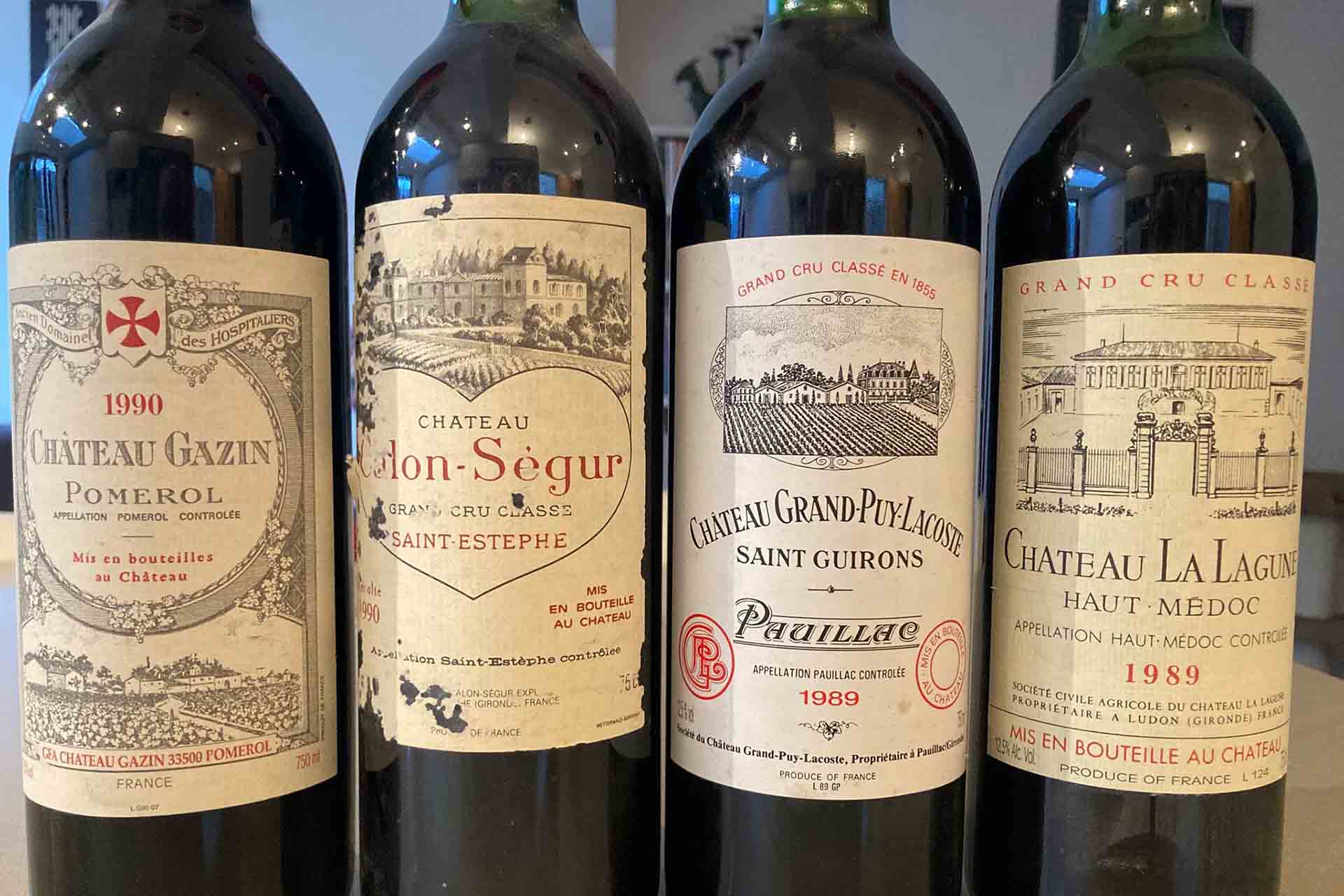
As with most tastings there were disappointments as well as successes, and the 1989 Chateau La Lagune Haut-Medoc was corked. The group voted on their favourites at the end of the session, and below are the top three, together with brief descriptions of the other wines. Mature Bordeaux wine tasting.
- 1995 Chateau Leoville Poyferre (Saint-Julien second growth)
The best wines from Saint-Julien on the Left Bank can display the structure of the more northerly Pauillac as well the more refined characteristics of Margaux to the south, qualities this wine displayed and it was voted the narrow winner. A blend of 75 per cent cabernet sauvignon, 20 per cent merlot and five per cent petit verdot. Still quite dark in colour but with a prominent garnet tinge, I could detect traces of youthful black fruit, which complemented the cedary, tobacco and liquorice characteristics that developed through ageing. The tannins were still prominent but not too obtrusive, the structure excellent. Drinking superbly but also has potential to age further.
£95 in bond, Falcon Vintners - 1990 Chateau Calon Segur (Saint Estephe third growth).
A close second. This had the wisdom of age without perhaps traces of the youthfulness found in the Leoville Poyferre (understandable given it is five years older). As is common for Saint Estephe, the most notherly of the famed Left Bank appellations, merlot accounted for a fair proportion of the blend (38 per cent), with 53 per cent cabernet sauvignon, seven per cent cabernet franc and two per cent petit verdot. Dried red cherry, rose petal, violets, truffle and mushroom. Beguiling. Available from some outlets in France but unfortunately hard to come by in Britain. - 1995 Chateau D’Armailhac (Pauillac fifth growth)
This was enthusiastically endorsed by critics towards the end of the last century (in 1998 Robert Parker said it was potentially the best vintage from the chateau he has tasted) and is still drinking beautifully. 42 per cent cabernet sauvignon, 32 per cent merlot, 26 per cent cabernet franc. As befitting wines from Pauillac, intense blackcurrant fruit is evident, and it still retains some primary characteristics, together with sweet pastry notes. Well-structured tannins but not obtrusive. I suspect this can keep for a bit longer.
£70, Lay & Wheeler
Best value option mature Bordeaux
1996 Chateau Chasse-Spleen (Moulis-en-Medoc, Cru Bourgeois Exceptionnel)
Proof that wine doesn’t have to come from one of Bordeaux’s classified estates to age well, and excellent value can be found elsewhere, such as this cru bourgeois from the Haut-Medoc, which Stephen Brook described as “exceptional” when he tasted it in 2005. 52 per cent cabernet sauvignon, 39 per cent merlot, five per cent petit verdot, four per cent cabernet franc. Medium-bodied, with silky tannins giving great structure. Pot pourri, rose petal and violets, dried red fruit and tobacco on the long finish.
£59, The Sipster
Other mature Bordeaux wines tasted
1996 Chateau Trotte Vieille (Saint Emilion Grand Cru Classe B)
From the Right Bank appellation of Saint Emilion. Fairly complex, dried blackcurrant and lavender. A bit raisiny and tannins a bit obtrusive.
£120, So Divin
1990 Chateau Gazin (Pomerol)
A Right-Bank wine from the Pomerol appellation. The blend is made up of 90 per cent merlot. Chocolate, sweet fruit and plumy. Good body, cedar and tobacco lingering on the finish. Complex. Should hold for a few years more.
£150, Amps Wine
1989 Chateau La Lagune (Haut-Medoc third growth)
Unfortunately this one was corked.
£90, Hedonism Wines
1989 Chateau Grand Puy Lacoste (Pauillac fifth growth)
Very savoury, leather and coffee. The fruit has faded and seemed past its best.
£150, Hedonism Wines
This article was written by Dan Hill, WSET Level 4 and owner of the Wine Flights blog, on behalf of Criterion Wine Tours. Dan is also a regular member of our London Wine, Dining and Travel Meetup group.